NFL Slams the Door on Brendan Sorsby, Denies Supplemental Draft Application Over Gambling Scandal
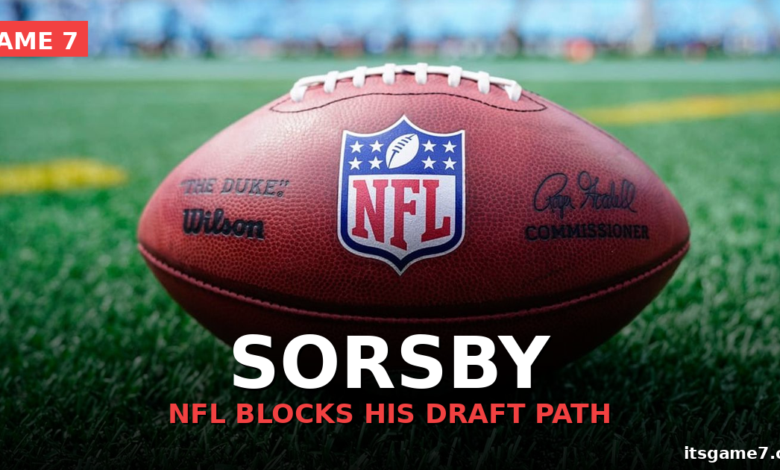
The NFL just told Brendan Sorsby he is not allowed in. The league announced this week that it will not hold a 2026 supplemental draft, which leaves the former Texas Tech quarterback with no path into the NFL until 2027 at the earliest.
Sorsby was the only player who applied. The league’s decision was effectively a personal answer to his case, dressed up as a procedural matter.
The official reasoning came from Larry Ferazani of the NFL management council. “The issues presented by your Petition are too significant, and too closely tied to the League’s core integrity interest, to permit meaningful review within the timeline presented,” Ferazani wrote in the letter to Sorsby’s camp.
Translation: the gambling scandal that ended his college career is not something the NFL is willing to rush through.
The league laid out the case directly. Sorsby, over the course of his college career, knowingly engaged in repeated and significant violations of NCAA rules designed to preserve the integrity of athletic competition. He did not provide the complete record of the NCAA’s investigation into his gambling habits, and he did not take accountability for his conduct in the application materials.
That is a sentence with no soft edges. The NFL is telling Sorsby that his version of events does not match its review, and the league has zero appetite for adding a player with that history during a period when sports gambling integrity is the No. 1 internal compliance concern.
Sorsby’s attorney, Jeffrey Kessler, is already pushing back. Kessler told ESPN that the NFL’s decision to not hold a supplemental draft “is a violation of the CBA and the law. We will pursue this immediately with the NFLPA.” Kessler is one of the most accomplished sports lawyers in the country, and he is not going to drop this quietly.
The CBA argument has merit on paper. The supplemental draft is part of the standard process for players whose eligibility status changed after the main draft. Skipping it because the only applicant is inconvenient is, at minimum, a procedural shortcut. But the NFL’s response is that the integrity carve-out gives the commissioner room to make exactly this kind of decision.
The legal fight will play out for months. The practical reality for Sorsby is that he is going to be sitting on a couch in 2026.
The league did leave one door open. The NFL “encouraged Sorsby to focus his efforts on possible entry through the standard 2027 NFL Draft.” That phrasing matters. The league is not banning Sorsby for life. It is sending him to the back of the line.
The question is whether the NFL will let him in even then. The same integrity concerns that blocked the supplemental application will still be in the file in 10 months. Sorsby would need to demonstrate genuine accountability, complete cooperation with any remaining NCAA and league reviews, and probably some form of public ownership of what he did before any team is willing to draft him.
None of that is impossible. Players with worse off-field histories have made it back to professional football. But it requires Sorsby to do the work the league says he has not done yet.
For now, the talent is wasted. Sorsby has a real NFL arm, the size and the mobility to play in any system, and the kind of college tape that, in a different career, would have gotten him drafted in the top two rounds. Instead, the gambling scandal got him kicked out of Texas Tech and now blocked by the NFL.
The next 10 months will tell us who Sorsby actually is. The league has handed him a clear assignment. Show real accountability, complete the process, come back through the front door in 2027. Whether he can do that, or whether the legal fight is the path he chooses, is on him now.
A longtime sports reporter, Carlos Garcia has written about some of the biggest and most notable athletic events of the last 5 years. He has been credentialed to cover MLS, NBA and MLB games all over the United States. His work has been published on Fox Sports, Bleacher Report, AOL and the Washington Post.
