
Kevin Durant Is the Biggest Weirdo in NBA History, and the Rockets Paying for It Proves Everything
Kevin Durant Is the Biggest Weirdo in NBA History, and the Rockets Paying for It Proves Everything
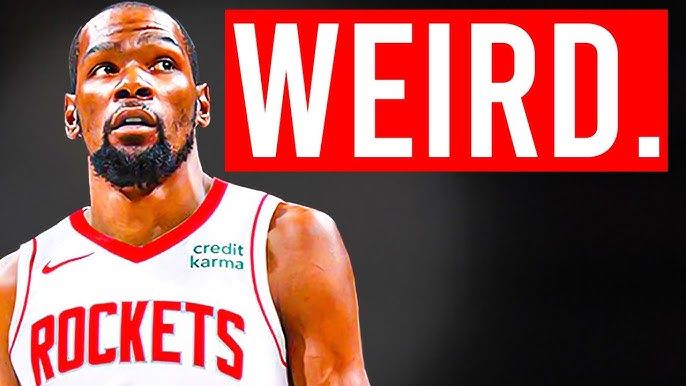
The Houston Rockets are down 0-3 to a Lakers team that has played this entire series without Luka Doncic and Austin Reaves. Last night, the Lakers came back from six points down in the final 25.4 seconds of regulation and won Game 3 in overtime, 112-108, at Toyota Center. LeBron James had 29 points, 13 rebounds, and six assists. Marcus Smart scored eight of the Lakers’ 11 overtime points and finished with 21 points, 10 assists, and five steals. The Rockets got at least 24 points from Alperen Sengun, Jabari Smith Jr., and Amen Thompson. It was not enough.
Kevin Durant was not on the floor. He was ruled out with a left ankle sprain he suffered in Game 2. But he was not on the bench, either. Durant was in the building but chose not to sit with his teammates during a must-win playoff game. Head coach Ime Udoka said afterward that Durant was “receiving treatment.” Whatever he was doing, he was not doing it next to the teammates who were fighting to keep their season alive.
That is Kevin Durant in 2026. His team is getting eliminated from the playoffs, and he cannot even be bothered to sit on the bench.
RELATED:
Did Mike Vrabel Father Dianna Russini’s Son Michael? https://t.co/z4K92Ym9Jc
— Game 7 (@game7__) April 23, 2026
The Lakers won Game 1 by nine while Durant sat out with a knee contusion he picked up in practice. Durant came back for Game 2, scored 23 points in the first half, then disappeared with just three points and nine turnovers in the second half as the Lakers won 101-94. His own teammate Jabari Smith Jr. publicly said it is “on him to find ways to get himself involved” and that the team still needs him to “be KD.” Then Game 3 came, and Durant was not even in the building as far as his teammates were concerned.
The Rockets are the fifth seed in the Western Conference with one of the greatest scorers in NBA history on their roster, and they are down 0-3 to a team whose two best scorers have not played a single minute in this series.
This is what Kevin Durant’s career has become. And this series is a perfect reminder of why Kevin Durant is the biggest weirdo in NBA history.
Durant had the talent to be the greatest player who ever lived. That is not an exaggeration. He is a 6-foot-11 scoring machine with a handle like a guard, a jumper that is functionally unguardable, career averages of 27.2 points, 7.0 rebounds, and 4.4 assists, four scoring titles, an MVP, two Finals MVPs, and four Olympic gold medals. He is the all-time leading scorer in USA Basketball Olympic history. At his peak, there was a real argument that Kevin Durant was the most talented offensive player the sport had ever produced. He had the frame, the skill set, and the resume to chase Michael Jordan. Instead, he became the most online athlete in the history of professional sports, and he chose trolling teenagers on Twitter over building a legacy anyone will remember with respect.
The team-hopping tells the story by itself. Durant spent nine seasons in Oklahoma City, where he won an MVP in 2014, made the Finals in 2012, and built something real with Russell Westbrook. Then he blew a 3-1 lead to the Golden State Warriors in the 2016 Western Conference Finals and responded by joining them. He signed with the team that had just beaten him. The team that won 73 games. The team that already had Stephen Curry, Klay Thompson, and Draymond Green. He called it pursuing greatness. The rest of the basketball world called it the weakest move in NBA history, and they were right.
He won two championships with the Warriors, in 2017 and 2018, and won Finals MVP both times. But those rings come with an asterisk so large you can see it from space, because he joined a team that had already won a championship without him and set the all-time wins record without him. The Warriors did not need Kevin Durant. They wanted him because he made them unfair, and Durant wanted them because they made winning easy. He took the most talented basketball career of his generation and removed all the difficulty from it, and then spent the next decade being furious that people noticed.
After three seasons in Golden State, he left for the Brooklyn Nets in 2019 following an Achilles tear in the Finals. He played three seasons in Brooklyn, requested a trade in the summer of 2022, and was shipped to the Phoenix Suns midseason. The Suns missed the playoffs in 2025, so Durant was traded again, this time to Houston in a seven-team deal last July. Five teams in 19 seasons. He has never stayed anywhere long enough to be the foundational piece of something lasting. LeBron James built legacies in Cleveland, Miami, and Los Angeles. Steph Curry became synonymous with Golden State. Tim Duncan was San Antonio for 19 seasons. Kevin Durant is a tourist. He shows up, puts up numbers, and leaves.
And what has he built in Houston? The Rockets finished 52-30 this season, the same record they had the year before he arrived. They dropped from the second seed to the fifth seed. Fred VanVleet tore his ACL before the season started, and rather than elevating the roster through that adversity, Durant’s Rockets slid backward. Durant averaged 26.0 points, 5.5 rebounds, and 4.8 assists on efficient shooting splits of 52 percent from the field, 41.3 percent from three, and 87.4 percent from the line. The individual numbers are pristine. The team results tell a different story. And now, in the first round of the playoffs, the team results are telling that story louder than ever.
Then came the KD Files.
During All-Star Weekend in February 2026, leaked screenshots from an alleged Durant burner account surfaced online. The account, operating under the handle @gethigher77, contained private group chat messages trashing current and former teammates. Alperen Sengun was described as a player who “can’t shoot or defend.” Jabari Smith Jr. was someone Durant allegedly said he “can’t trust to make a shot or get a stop.” In one message, the account referred to former teammate Devin Booker and former Suns head coach Frank Vogel as “two dictators.” The messages also contained disparaging comments about Russell Westbrook, James Harden, and Kyrie Irving.
When asked about it at Rockets practice, Durant’s response was: “I’m not here to get into Twitter nonsense.” He did not deny it. He did not confirm it. He just dismissed it as beneath him while refusing to actually clear his name, which is exactly what someone who runs burner accounts would do. NBA analyst Antonio Daniels said the scandal “fractured” the Rockets locker room. Multiple reports indicated the team was split over the revelations.
This is not even the first time. In 2017, Durant was caught using a burner account when he accidentally tweeted from his official account in the third person: “He didn’t like the organization or playing for Billy Donovan. His roster wasn’t that good, it was just him and Russ.” He was defending himself to strangers on the internet and forgot to switch accounts. He later apologized and called the tweet “childish and idiotic.” In 2019, he admitted to using burner accounts to “interact with friends.”
The pattern is not complicated. Kevin Durant is a 37-year-old man who has made over $400 million playing basketball, won two championships, won an MVP, won four Olympic gold medals, and still cannot stop arguing with anonymous accounts on the internet. He has said publicly that responding to trolls is his “coffee in the morning” and gives him a “dopamine hit.” He said this on Netflix’s Starting 5 documentary, as though it were charming instead of deeply strange. He vowed to “troll on Twitter til the day I expire.” He once stayed up until 5 AM trolling people after an Olympic win over Serbia instead of celebrating with his teammates.
That is not normal behavior for a top-five talent in the history of basketball. That is the behavior of someone who cares more about winning arguments with strangers who have never picked up a basketball than about the actual basketball. LeBron James at 37 was chasing scoring records and willing his team into playoff contention. Michael Jordan at 38 was lacing up his sneakers for the Wizards, but at least he was doing it on a basketball court. Kevin Durant at 37 is on his fifth team, down 0-3 in the first round, and he did not even sit on the bench for Game 3. He was in the arena and chose not to be with his teammates while they fought to stay alive. His own teammate has publicly said it is on him to figure it out, and the internet is still debating whether he was the one trashing his roster from a burner account three months ago.
The talent was never the question. Kevin Durant might have the most purely gifted offensive skill set in the history of the sport. The question was always what he would do with it. And the answer turned out to be: join a 73-win team to avoid having to beat them, leave every organization he has ever been part of, trash his teammates from anonymous accounts, argue with teenagers online for dopamine, and end up on a fifth-seeded Rockets team that is down 0-3 to a Lakers squad missing Luka Doncic and Austin Reaves while he watches from somewhere inside the arena, not even willing to sit on the bench next to the teammates he allegedly trashed from a burner account.
He had the potential to be the greatest of all time. He had the height, the handle, the shot, and the resume to get there. Instead, Kevin Durant became the most talented player in NBA history to completely waste his own legacy, not because of injuries or bad luck, but because he would rather be the most online guy in professional sports than the best basketball player on the planet. He chose being a weird, bitter, terminally online troll over greatness, and the Rockets are paying the price for it right now.
That is Kevin Durant’s legacy. Not championships. Not MVPs. Not Olympic gold. The guy who could have been the greatest of all time and instead became the NBA’s most famous internet troll. Last night his team lost a heartbreaker in overtime to go down 0-3, and Kevin Durant was not even sitting with them when it happened.
A graduate from the University of Texas, Anthony Amador has been credentialed to cover the Houston Texans, Dallas Cowboys, San Antonio Spurs, Dallas Mavericks and high school games all over the Lone Star State. Currently, his primary beats are the NBA, MLB, NFL and UFC.
