Duke Got Robbed. UConn Should Have Lost Twice in 0.4 Seconds.
Duke Got Robbed. UConn Should Have Lost Twice in 0.4 Seconds.
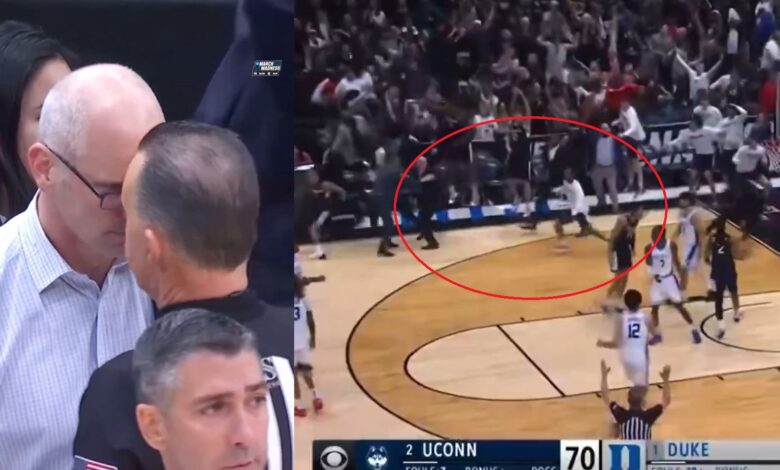
Braylon Mullins hit a 35-foot three-pointer with 0.4 seconds left to give UConn a 73-72 win over Duke in the Elite Eight on Sunday night. It was the shot of the tournament. The kind of moment that gets replayed for decades.
But what happened in the seconds right after it might matter just as much as the shot itself.
Dan Hurley, UConn’s head coach, walked toward a referee on the sideline. He got in the official’s face. Then he pressed his forehead directly into the ref’s forehead. Sports Illustrated called it a “menacing forehead tap.”
DAN HURLEY AND THE REF 😭
Hurley’s reaction to UCONN’s game-winner
(via @MarchMadnessMBB) pic.twitter.com/Wa8IbyE44q
— Bleacher Report (@BleacherReport) March 30, 2026
The game wasn’t over. There were still 0.4 seconds on the clock.
No technical foul was called.
If it had been, Duke would have shot two free throws, trailing by one. In college basketball, any player on the team can shoot technical free throws. Duke’s best option was Isaiah Evans, who shot 86% from the line this season. Make both, Duke wins 74-73. Make one, overtime at 73-73, with Hurley ejected and coaching from the locker room.
Instead, nothing was called. The 0.4 seconds ran off. UConn celebrated. And now they’re in the Final Four.
That Wasn’t the Only Thing the Refs Missed
When Mullins’ shot went through the net, several UConn bench players jumped off the bench and ran onto the court to celebrate. They realized the game wasn’t technically over and scrambled back, but they had already entered the playing area during a live ball.
The Duke radio call after UConn’s game winner 😭😭😭
“Malachi Smith ran off the bench! That should be a technical!” pic.twitter.com/WzPgrV9NDC
— BrickCenter (@BrickCenter_) March 30, 2026
The NCAA rulebook is specific about this. Bench personnel entering the court before player activity has been terminated is a technical foul. Duke’s radio announcers immediately called for one on the broadcast.
That wasn’t called either.
So within 0.4 seconds, UConn committed two separate violations that could have each resulted in a technical foul. Neither was whistled. Duke never got to shoot free throws.
Three Games. Three Incidents. Three Weeks.
Here’s what makes the Hurley moment against Duke so much harder to write off as a one-time thing.
Three weeks earlier, on March 7, Dan Hurley was ejected from UConn’s regular season finale at Marquette. In the final second of a 64-62 game, Hurley argued that Silas Demary Jr. was fouled on a drive to the basket. He charged toward referee John Gaffney and got his chest right next to the official’s shoulder.
He was hit with a double technical and ejected. Marquette shot four free throws, converted all of them, and won 68-62. The Big East fined Hurley $25,000 for unsportsmanlike conduct. He avoided a suspension.
Then on March 27 in the Sweet 16 against Michigan State, Hurley challenged an out-of-bounds call, got it overturned in UConn’s favor, and then sarcastically offered his glasses to the official who made the original call. Lip readers caught him asking the ref if he’d ever tried Lasik. No punishment was given.
Carlos Boozer spent March Madness mocking other teams and other fans.
Tonight came the karma.
The basketball gods are undefeated.
Here’s the real story of how the Boozer family went from waving goodbye to getting waved out of the tournament in 48 hours:
Carlos Boozer played… https://t.co/LwMFLUZ0AH
— Game 7 (@game7__) March 30, 2026
Two days later, against Duke in the Elite Eight, Hurley was officially “warned” during the game for leaving his coach’s box to argue with officials. He was told to stay put.
Then after the buzzer beater, with 0.4 seconds still on the clock, he walked up to a referee and pressed his forehead into the official’s forehead.
Three games in the span of three weeks. Ejected and fined $25,000 at Marquette. Nothing at Michigan State despite taunting a ref to his face. Then warned during the Duke game for leaving his coach’s box, followed by forehead-to-forehead contact with a ref in the biggest moment of the season.
Each incident more aggressive than the last. The consequences went in the opposite direction.
The Math That Didn’t Happen
The scenario is simple.
If the technical on Hurley had been called, Duke gets two free throws trailing 73-72. Evans steps to the line at 86% for the season. The probability of him making both is roughly 74%. The probability of him making at least one and sending it to overtime is over 98%.
If the bench violation had been called instead, Duke still gets free throws trailing by one. Even a single make ties the game and sends it to overtime.
Either call likely changes the outcome of the game. Neither was made.
The Bigger Question
Nobody is arguing that Braylon Mullins didn’t earn that shot. The 19-point comeback was real. The steal was real. The shot from 35 feet was one of the most clutch moments in NCAA Tournament history.
But the NCAA rulebook exists for a reason. Contact with a game official is a technical foul. Bench players entering the court during live play is a technical foul. These aren’t judgment calls. They’re black-letter rules.
Dan Hurley has won two national championships in a row. He might be the best coach in college basketball. His teams play with an intensity that is impossible to fake. But that same intensity has now produced an ejection, a $25,000 fine, multiple warnings, and a forehead-to-forehead confrontation with a game official in the span of one month.
UConn is in the Final Four for the third time in four years. They came back from 19 down to beat the number one overall seed on a shot that will be replayed forever.
But the question that won’t go away is whether they should have ever gotten the chance to celebrate it.
A longtime sports reporter, Carlos Garcia has written about some of the biggest and most notable athletic events of the last 5 years. He has been credentialed to cover MLS, NBA and MLB games all over the United States. His work has been published on Fox Sports, Bleacher Report, AOL and the Washington Post.
